Showing posts with label Robotics. Show all posts

Robotics Drives Utilitarian Digitization of Finance


Finance might be one of the most complex professions to work for; with ever-changing landscapes, regulations, accounting standards to ever-increasing data, expenses and forex fluctuations. Thus, it has become extremely necessary for top financial and accounting firms to stay vigilant and keep up with the changes.

One of the key changes one can implement is automation. This change will help to streamline and enhance the efficiencies of various processes by leveraging new technology made accessible to us through digitization. One of the major building blocks of any firm is accounting and like other branches, it can also draw huge benefits from robotic automation.

Albeit, the techniques used in accounting procedures have remained constant over a few years. The efficiency of these procedures can be increased by introducing automated cloud accounting software.

“It is time for businesses to move on and adopt new and innovative tech disruptions if they want to survive and make a successful future.”

Time to Discard Old Practices

Let’s go through a list of factors that are archaic and redundant but are still being practiced by conventional accounting in businesses.

1. Fraught With Human-Errors: Traditional accounting practices demand a lot of data entry, which increases the chances of data entry errors and requires personnel to go over them twice or thrice to ensure accuracy.

2. Mundane and Monotonous Work: Traditional accounting practices require a lot of patience and time to perform work which is repeated and redundant. These naturally require long work weeks, diminish the output and additionally results in higher incurred expenses.

3. Keeping Records is Cumbersome: For any business, keeping all records pertaining to finance and accounts is mandatory. Now, to store them in a systematic manner, over the years, requires manpower and consumes time. This surely burdens the businesses economically.

4. Limited Accessibility: The approach to these records is confined only to those professionals who specifically worked on these documents. This becomes a big hurdle for the business as a new person will take time to go through it.

5. Lacks Customer Friendliness: It obviously cannot be beneficial for customers as all the functions move so slowly.

Why Automate?

To overcome these shortfalls, businesses are now adopting modern technologies.

Using cloud accounting software, accounting organizations are automating these tasks with minimum human involvement.  
  • Journal entries,
  • Reconciliations and
  • Preparing financial statements and documents

The biggest advantage of adopting business accounting software is that it essentially provides accounting personnel to stay on top of these procedures.

Historically, accountants' time was taken up by compliance work which made it harder to view financial and operational data in real-time.

But with automation, the scenario has changed drastically and now they get more time to:
  • Analyze,
  • Stay in sync with changing regulations and
  • Make strategic decisions.


Hence, they can play a more productive role in the company.

Robotic Process Automation – An introduction!

Robotic process automation (RPA) is the application of the software that imitates human engagement with basic systems, web and desktop applications to carry out processes. It automates processes by accessing user interfaces without underlying programs.

Due to its low cost, if this automation technology is well implemented, it will provide a significant return on investment.

Being an automation option, RPA could be compared to Enterprise Resource Planning System (ERP) upgrades, switching on ERP modules and specialized accounting software (for example- reconciliation and consolidation).

RPA can be used strategically as part of a holistic process improvement program or tactically to automated redundant as-its procedures.

Due to its user-friendly interface, it can be taught using minimal training and proper communication.

Using automated cloud accounting software, we can harness a plethora of advantages and streamline our process.

Advantages of Cloud Accounting Software

Advantage #1: Accuracy of data: With the disappearance of manual entry, automated tools provide more reliable and error-free data.

Advantage #2: Increased efficiency: Accounting teams can improve their project management style to focus more on analysis and global strategy, which could be based on the results of automated procedures.

Advantage #3: Transparency: Automated procedures leveraging on business cloud accounting software can provide their users with transparently stored data, making it easy to access for everyone involved.
Advantage #4: Better Client Collaboration: Auditing procedures require a lot of data to be imported from clients to book-keepers and accountants. Automated cloud-based tools provide a reliable solution for more comprehensive and faster sharing of data to streamline processes at both ends.

Advantage #5: Rapid implementation: With the availability of user-friendly cloud-based automation software, the implementations of these tools require basic training and are easier to learn.

Benefits to Accounting Functions from Automation

The Accounting functions which can certainly benefit from automation and capitalize on new opportunities are as follows:

Benefit #1: Financial Reporting: Financial reporting might be the field that would benefit most from the automation of accounting software.

Automation of financial reporting will expedite audits, build solid financial statements across different countries, accounting for changes in reporting standards (IFRS, US GAAP, among others).

Preparation of consolidated annual reports and financial statements has also become easier, providing correct data to analyze multiple-entity performance during a cycle.

Benefit #2: Standardization and Reconciliation: Automation can help in easily customizing content, prepare user and client-friendly reports and build an efficient format that can help in maintaining a superior standard of reports over a long period of time.

Benefit #3: Finance Business Process: Workflow and division of tasks are much easier using cloud-based automation tools, ensuring personnel having clear-cut tasks for them while being in contact and noticing what the rest of the team is doing.

Benefit #4: Financial Modelling and Analysis: With automation, excel-sheets have seen a significant cut in errors, which helps management to make the correct decisions by letting them analyze information that is reliable.

Benefit #5: Tax procedures: In Tax procedures, RPA (Robotic Process Automation) is used to create automation, configured to repetitive processes such as submitting filings to tax authority web portals, which as said earlier, frees up the tax team to perform higher quality work such as research and planning.

“Accounting firms, even if small in size, can capitalize on this disruptive technology and streamline their business as much as possible.”

However, careful planning is needed to incorporate automation in the already existing business model. This can be done in the following ways:
  1. Carefully planning the procedures that could benefit from automation and not disturb the procedures that are perfectly optimized. Once these processes are selected, then choose the best cloud accounting software that will fit perfectly with the business unit and its existing IT setup.
  2. After the planning, the next step is to involve all personnel and ensure they understand the new flow of processes and documentation. This step is critical to the efficiency of the whole operation because, if the new flow of order remains unclear, then delays would be caused and information could also be lost as a result.

Automation processes have their own hiccups as well; therefore, it is crucial to ensure that these points are addressed well before the implementation of accounting software is being planned.

Some of the problems that accounting firms have encountered during their successful implementation of automation based cloud tools are as follows:
  • Uncertainty in the workplace

Automation by some organizations was regarded as a process to streamline their expenses. This perception often creates a sense of uncertainty around the workforce as they feel apprehensive about losing their job etc.
  • Data privacy & regulations

The problem with the digitization of accounting is that very crucial documents and management reports can be accessed unfairly by people involved in wrongdoings online. With bodies like the European Union already planning changes in regulations, the storage of data becomes a key criterion for firms who want to use automation tools to judge firms providing these services.
  • Training issues

As more and more sophisticated automation software are coming up, firms become short-staffed in having experienced personnel who can train other personnel to undergo a successful implementation phase. Thus, improper training always leads to not fulfilling the potential final outcome and falling short in meeting the future targets set based on this change.
  • Reliability of cloud-based automation tools

As disruption within the tech space is so prominent, one can never be fully sure that the software that is the best accounting tool now will be the best in the future. Thus, thorough key research needs to be done by businesses beforehand so as to keep a competitive edge over other peers and not let it slip.

“But we should not be worried about these obstacles, as, with proper planning, it is possible to go through a smooth transition.”

Some of the factors that help in the implementation of the best accounting software are as follows:

Factor #1: Better training programs

Hiring experienced or already possessing a change management team in the firm would really harness the full potential of the automation procedure: pre, during and post-implementation. It would be beneficial to include accounting experts who are well versed in automation processes and realize how to steer the ship.

Factor #2: Proper due-diligence

Accounting firms need to perform thorough research about their needs, automation tools available and finding the best accounting software that will create a synergy with the existing procedure.

Factor #3: Data handling capabilities

Having personnel that has experience handling chunks of data and have the knowledge of data regulations and privacy protection would always be beneficial.

“Financial services firms should consider investing in automated cloud accounting software that will not only streamline their processes but also produce a quicker output and finally speed-up their businesses.”

The Final Word

As change is the law of nature, it is imperative for accounting companies to go with the flow and embrace the new, innovative tech disruptions.
The future of accounting will undoubtedly be shaped up by artificial intelligence and machine learning; therefore, being in sync with automation is not an option but a necessity for accountancy firms.

In Robert Half’s “Jobs and AI Anxiety Report,” RPA has been described as a way for businesses to automate tedious or repetitive processes to save time and money and increase employee productivity. Data from this survey shows that 79% of managers in the United States employ automation right now or expect to do so within the next few years.

Thus, it is clear that the firms that opt to upgrade themselves and their personnel with the best accounting software at the earliest will be the ones who will reap the highest benefits.

‘A futuristic approach, teamed with intelligent and strategic planning, will lead to definitive success for businesses in general and accounting firms in particular.”

Artificial intelligence and human intelligence can come together to make the best of it; it will promote insightful practices, add value and increase efficiency. It is a partnership that will usher in a new and progressive period for accounting firms, bringing about rich dividends in the future.
People working in the finance and accounting industry, need to upgrade themselves by acquiring new skills that match with the latest tech developments in accounting software.

The industry and the professionals are all ready to embrace the change that is coming their way due to robotic automation and artificial intelligence.

Tech disruptions always keep changing. Thus, it is essential for a firm to be an industry leader when it comes to implementing changes and additions. ‘First mover advantage’ is a big factor, especially in the financial services industry and to maintain that innovation is key.

“Using new technology to perform operations, always demands new and innovative solutions to come out as a byproduct.”

Continue Reading

Robotics + Finance = A Smart Partnership


Robots Have Arrived In Finance

For a layman pronouncing ‘robot’ pops up the image of ‘Star Wars’ creatures, a distinctive creature which is the product of imagination.

In reality, robots or robotic processes actually have arrived in a big way and is now helping humans accomplish lots of technical work.

From using mechanical robots assisting in assembling products or accomplishing manual-routine chores, modern technological advancement has led to robotic automation in various processes.
Robotic Process Automation (RPA) also known as Robotics has recently been introduced in the world of corporate finance and changed the entire financial landscape.
Business leaders are recognizing that disruptive technology is playing a pivotal role in transforming finance capability.

Decoding RPA

Simply put, Robotic Process Automation (RPA) is a user-friendly software that has the ability to perform high-volume, routinely repeatable tasks easily and efficiently with the help of Artificial Intelligence (AI). It has the ability to mimic humans with the added benefit of reducing time and eliminating errors in what is otherwise a cumbersome, mundane work.

This is what Capgemini has to say regarding this exponential technology, “As a virtual worker, RPA replicates user actions to reduce or eliminate human intervention in mundane, repetitive, and manually intensive processes.”

Defining RPA, Deloitte says, “RPA is computer-coded software, commonly referred to as BOT, that emulates human actions and is able to drive automation of rule-based processes. It is an ideal automation technique for any process that has heavy dependence on data entry, data manipulation, triggering responses, and communicating with other digital systems.”

KPMG, on the other hand, defines RPA in these words, “RPA is the simplest form of digital labor. Its significance is that it enables data to be collected, analyzed or calculated at a speed and scale far greater than a human or team of humans could manage.”

“Preconfigured software which reproduces the work that humans do, and hence, they are called robots, or software robots. In short, RPA robots automate human tasks.”

Tasks Best Suited For RPA

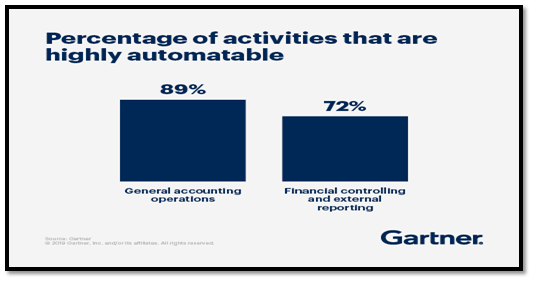
Talking about the adoption of RPA in finance and accounting, Gartner brings to light the high percentage of processes that will benefit from its implementation. 

Here is a list of tasks that can be automated with great success:
  • Tasks that are data intensive.
  • Work that involves manual calculation.
  • Tasks that face a high error rate.
  • Actions that require an electronic trigger.
  • Tasks that are repetitive in nature.
  • Actions that have electronic start and endpoints.
10 Functions That RPA Can Advantage

The most common functions that can draw benefit from robotic automation in finance and accounting are:
  1. Accounting and Reporting
  2. Internal Audit and Compliance
  3. Payroll
  4. Tax
  5. Accounts Payable
  6. Accounts Receivable
  7. Budgeting and forecasting
  8. Treasury Management
  9. Expense Management
  10. Inventory Management
How Is Robotics Advantageous?

Companies and finance personnel who have adopted and applied robotics to perform numerous financial functions at a very early stage are reaping the benefits already and this has motivated the Industry to embrace RPA in a major way.

8 Benefits Derived From RPA
  1. It assists in streamlining the process.
  2. It is more efficient and fast, hence, saves time.
  3. It helps in minimizing cost.
  4. Human resource is freed from time-consuming, monotonous tasks.
  5. It greatly reduces the chance of errors.
  6. It motivates and empowers the workers towards more productive work.
  7. It helps to move towards a modern and futuristic approach.
  8. It undoubtedly increases scalability and enhances flexibility.
These are some of the reasons why more and more finance leaders are keen to apply this techno-vation in their businesses or companies.

“Global investments in AI and Robotics are on the rise, thanks to their promise of cost-efficiency, agility, sustainability, and quick ROI.”

Future of Business: Artificial Intelligence and Robotics 

Let us examine how these entities will benefit by embracing RPA in finance:
  • Ushers greater efficiency
  • Ensures accurate and secure compliance
  • Improves productivity
  • Gains competitive advantage
Thus, there is no wonder that the adoption of robotics is set to skyrocket businesses in the near future.
A Gartner research indicates that Robotic process automation is being embraced by many finance leaders to reduce costs, improve compliance and structure more efficient finance teams.

In the year 2020, RPA is supposed to take a big leap as is projected based on the findings of this research.

Source: Gartner

 Cost-effectiveness comes out as the biggest lure for the implementation of RPA.
Source: Gartner

In Finance 2020, Accenture reiterates almost the same views and states, “Digital is killing your finance organization as you know it. But there is no reason to mourn the loss. Accenture analysis shows that by 2020, cross-functional integrated teams will deliver 80 percent of traditional finance services. Staff productivity will increase by two to three times. As a bonus, costs will decline by 40 percent.”

Not to be left behind, Ernst & Young is also completely in favor of applying automation in finance at the earliest and presents the benefits from RPA thus:

Source: Ernst & Young

Extensive Scope Of Robotics In Finance

Paul McDonald, senior executive director, Robert Half, very rightly said, “People and their relationship with technology, or more specifically, how they work with and apply technology in new and imaginative ways, will help define the new world of work.”

According to a worldwide survey of more than 400 organizations by Gartner, Inc. regarding the deployment of top emerging technologies by 2020, Christopher Iervolino, senior director analyst at Gartner has some interesting facts to share.

He states, “More than a quarter of organizations surveyed expect to deploy some form of artificial intelligence (AI) or machine learning in their finance department by 2020. Moreover, half of the respondents expect to deploy predictive analytics in the same period.”

A Robert Half survey held recently concluded, “79% of managers in the U.S. are either currently using automation or expect to do so within the next three to five years.”

Once throwing light on the need to automate in finance, Paul Bulpitt, the head of accounting at Xero and founder of The Wow Company commented, “Historically, it has been hard to provide value-added services due to their (accountants) time being taken up with compliance work and an inability to view financial and operational data in real-time.”

At the moment, the implementation of RPA covers superficial and basic processes, yet it has made a sea difference.

For example, by using cloud accounting software, accounting firms and professionals are able to automate most of the tasks with minimum human involvement.

This has helped to change the scenario a great deal for professionals as they get more time to analyze, stay in sync with changing regulations and make strategic decisions and hence, play a more productive role in the company.

A survey by Deloitte in 2015 to gain an insight into the scope of automation in the coming 10 years showed that more and more entities intended to adopt it in the near future.


Source: Deloitte

Not stopping at this, the Deloitte Survey throws light on how the businesses further intend to automate and take advantage of the latest automotive inventions. 


Source: Deloitte

Affirming the vast reach of robotics, Mr. Ashwani Kohli, Director, Intelligent Automation, PwC South East Asia Consulting, commented, “Besides the traditional accounting operations, RPA is also having an impact on audit, tax planning, and statutory and regulatory reporting processes.”

Hurdles in the Way of Robotic Automation

There is no doubt about the overwhelming benefits that can be drawn from robotics in finance but the biggest challenge lies in its implementation.

Even while embracing automated accounting software, a company needs to plan and strategize thoroughly because a lack of preparedness will not give the desired result.

Capgemini’s advice on this front carries a lot of meaning for those businesses that are looking to implement robotics, “As an organization that is constantly looking for opportunities to improve its processes, Capgemini understands the speed at which robotic automation can transform a business. However, it also understands that a lack of proper preparation before introducing robotics can lead to a start-and-stop implementation.”

Gartner, the world’s leading Research and Advisory Company also echo the same sentiment and says, “To achieve the full benefit of robotic process automation (RPA), corporate controllers need to restructure their workforce to enable automated work, free from human interference”.

Here are a few crucial footsteps that a firm has to take for successful implementation of robotics:

Footstep #1: Allay the fear and concern of Employees: The utmost problem is the apprehension of employees that the robots are here to replace them. This distress about job insecurity should be addressed by employers as a pre-work, giving them insight into how robots will assist and ease their work but not render them jobless.

Professor Michael Davern, Professor of Accounting & Business Information Systems, at the University of Melbourne in Australia, very rightly comments, “Fears of RPA replacing workers are as unfounded as earlier concerns that computerized spreadsheets would replace accountants. RPA is about automating tasks, not entire processes.”

Footstep #2: Train the Workforce: It is quite true that there is a dearth of trained and qualified employees to work with RPA and hence, it is the duty of companies to train and upscale its employees. Proper guidance towards its implementation will ensure a 100% reward.

Feon Ang, vice president for talent and learning solutions, expressed his views on how workers can remain relevant in the future and said, “It’s important for companies to continue to invest in their people so that they are upskilling and reskilling their people to keep up with the roles that are in demand.”

Footstep #3: Safeguard Data privacy: A firm’s biggest concern in sharing data is its privacy that can be attained using cloud accounting software, that ensures complete data security, backup, and restoration.  

Footstep #4: Connect all dots: The Company should make sure that no gaps are left in the process otherwise the results will not be as expected.

Robotics: Making Future ‘Perfect’

Laying stress on the role of automation in a global economy, KPMG states, “The Fourth Industrial Revolution is quickly unfolding as the evolution of artificial intelligence, IoT, and robotics move firmly into the mainstream and upturn media, transportation, healthcare, security, retail, telecom, and many other fields.”

Acknowledging the immense economic and social power that is derived from tech disruptors, the modern global leaders, across varied industries, are eager to embrace them in the near future, if not already adopted.

Change is a necessity that leads to progression and advancement and hence, should not be perceived as an intimidating factor, instead, it should be welcomed. Thus, in order to reap the rich dividends of robotics, it is mandatory for industry leaders to adopt and adapt innovative automation tools.

It is imperative to comprehend that Artificial intelligence and human intelligence are not in conflict with each other; on the contrary, the partnership enhances efficiency, encourages insightful practices and stimulates growth.

The pros of Robotics in finance are quite evident and therefore, the success of businesses and individuals lies in adopting it at the earliest and with complete preparedness. Its adoption in finance is no more a choice but has become a necessity as with time more innovative and disruptive tools will be added to RPA, leading to complete automation of processes.  

The existing transforming tools have already shown excellent trends and the success of companies who have been able to take the “first-mover advantage” is a motivator for others.

Conclusion

Change, which is affected by tech disruptions, may create anxiety and uncertainties but its successful implementation yields escalated growth and progress. To keep pace with others, it is essential to embrace transformation at the same speed; otherwise, it will lead to stagnation.  

Robots, which were initially portrayed in a negative light and therefore, businesses and individuals, were reluctant to embrace it, but with time it has stood the test and proved as a remarkably useful tool.

The introduction of automation and artificial intelligence in business has transformed the entire landscape and finance cannot be left untouched by it. Although there was an initial reluctance by the professionals of this field in opening up to the new technologies like automated cloud computing or RPA, eventually they saw the huge advantages it brought.

Today most of the professionals and firms are capitalizing by leveraging robotics and transforming the entire financial landscape. This has helped financial personnel to upskill themselves and add more value to their jobs, thus, bringing-in more job satisfaction.

Robotics promises to promote and encourage great advancement in financial functions if only the leaders overcome the hurdles that come in their implementation!
Continue Reading